

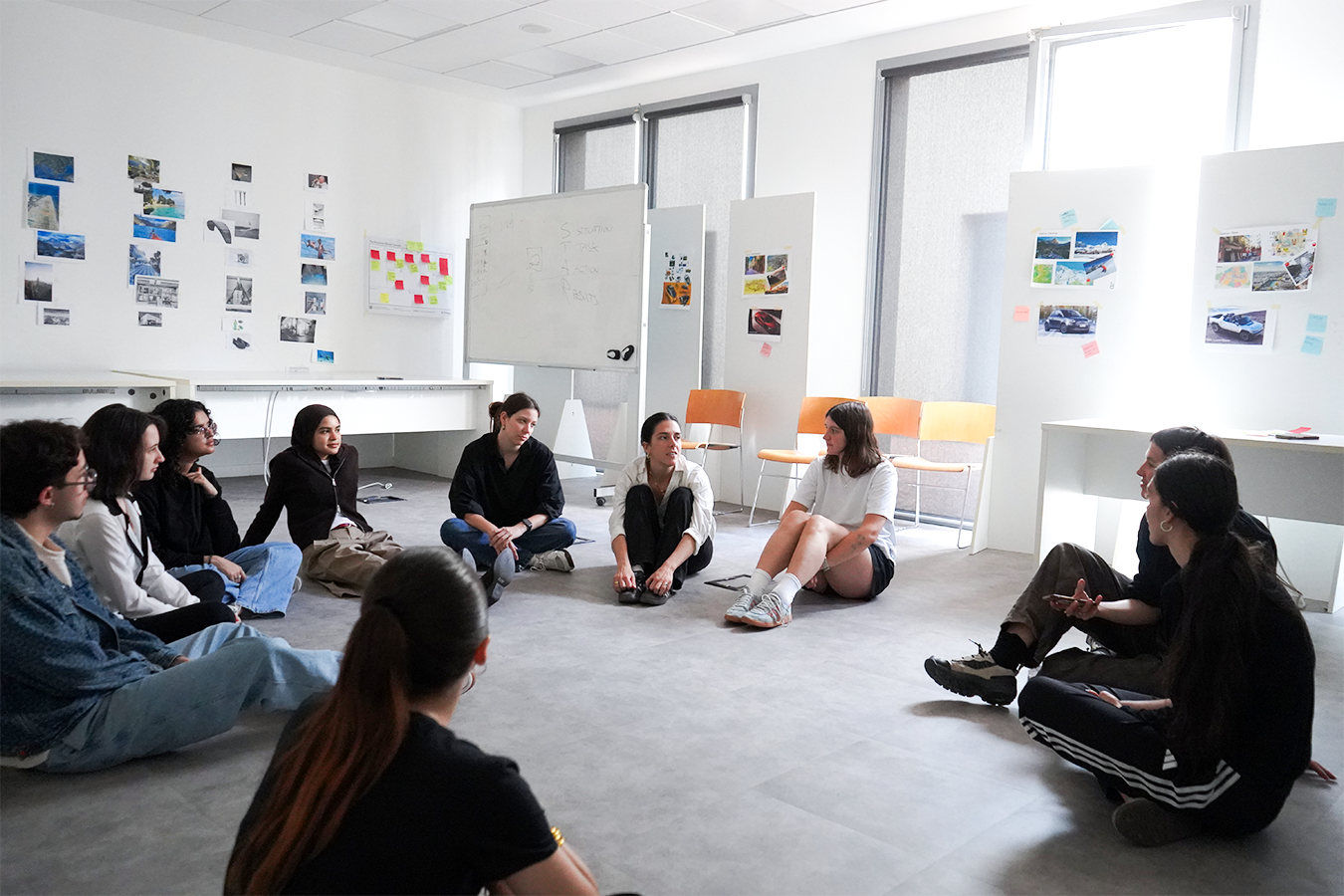
As part of the Immersive Practices workshop, choreographer and performer Federica D’Aversa led the students of the Master MEED in Event and Exhibition Design through a powerful exploration of how space can be shaped—and felt—through the body. The workshop was made possible thanks to the collaboration with Studio Wok and Associate Studio.
The Body as a Tool for Spatial Awareness
D’Aversa’s approach starts with a simple but profound idea: our presence affects space just as much as space affects us. By connecting body, space, and atmosphere, she guided MEED students toward a deeper awareness of how immersive environments are not only created—but inhabited, sensed, and transformed.
Workshop Highlights
Through two distinct moments—Sensitization and Body Opening and Exploration through Improvisation—students participated in physical and perceptual exercises to unlock their own spatial intelligence.
-
Body Choices and Spatial Impact – How our posture, movement, and gestures redefine the scale and intention of a space.
-
Individual vs Collective Presence – The dynamic between solitary movement and group flow, and how collectivity generates new atmospheres.
-
Internal and External Space – What does it mean to contract or expand a space through creative expression? How does the environment shape our behavior?


A Dialogue Between Body and Atmosphere
The guided improvisations drew inspiration from artistic and theoretical references including Alberto Burri, Lucio Fontana, and William Forsythe. D’Aversa emphasized proprioception—our ability to sense our own body in space—as a critical tool for designing immersive environments that feel lived-in and emotionally resonant.
Space as Matter, Body as Medium
“My research focuses on space that becomes matter through the body, and the body that is shaped by space,” D’Aversa explained.
Her experience as a performer taught her that space offers more answers than questions—if we allow ourselves to move through it with openness and sensitivity.
A New Perspective on Design
For the MEED students, the workshop wasn’t just about movement. It was about understanding design from the inside out. D’Aversa reminded them that immersive spaces begin with the body—not just as a user, but as a creative instrument.
“Proprioception helps us make sensitive choices,” she said, “in dialogue with the material world and with the inner spaces we carry.”
This workshop left students not only inspired, but grounded in a new way of thinking: the body is not separate from design—it is design.